

For most athletes, race simulation workouts produce faster specific adaptations for HYROX because they replicate the exact demands of the event. However, block training remains superior for building the foundational strength and aerobic base required to sustain high intensity. At Colfax Strong Strength & Conditioning, an official HYROX affiliate, we integrate both styles to ensure you are race-ready without burning out.
Race Simulation Workouts
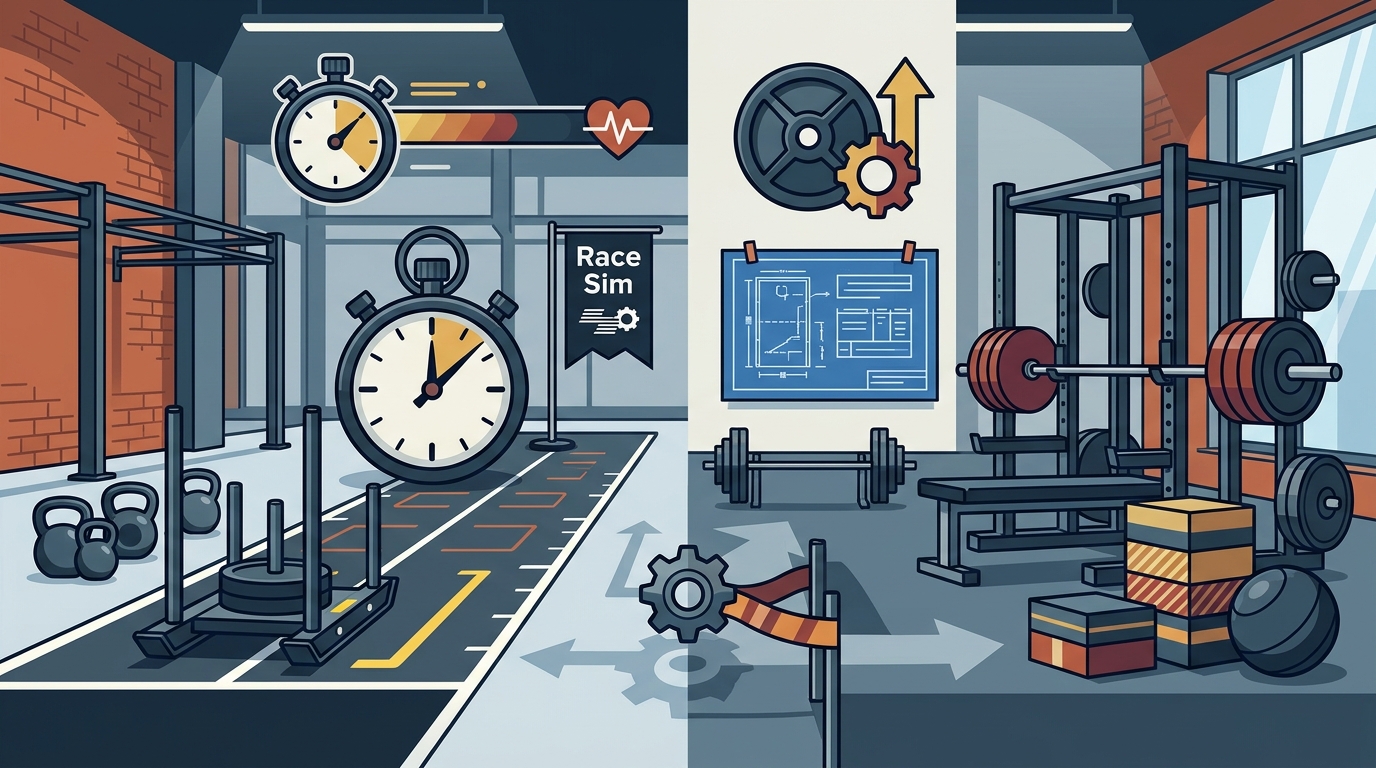
Race simulation is a training method that replicates the specific sequence, intensity, and duration of a competition. In the context of HYROX, this means performing the eight stations (running and functional movements) in the same order as the race day. This style forces your body to adapt to the specific fatigue patterns of the event. It teaches you how to pace your running segments relative to the lifting segments. You learn when to push and when to conserve energy. This specificity is the primary driver of performance on race day. If you have already built a solid base, this style yields the highest return on investment.
Strengths of Simulation
The primary strength is specificity. Your nervous system learns the exact transitions between running and lifting. You practice the mental resilience required to finish the final stations. This style also helps you identify weak points in your race strategy. For example, you might discover that your sled push technique degrades after the second run. Fixing this in training prevents it from costing you time in competition. It builds confidence because you have already experienced the full race intensity.
Limits of Simulation
The main limit is recovery demand. Full race simulations are highly taxing on the central nervous system. Doing them too frequently can lead to overtraining. They are not ideal for building raw strength or maximal power. If you are a beginner, full simulations may be too intense to perform safely. They require a certain level of fitness to be effective. Without a base, you may simply be practicing poor technique under fatigue.
Block Training for Hyrox
Block training is a periodization strategy that divides training into distinct phases, each with a specific focus. For HYROX, this typically involves blocks dedicated to aerobic capacity, strength, and power. This style builds the engine and the muscle required to perform the race. It does not replicate the race sequence but instead builds the components that make up the race. This approach is safer for beginners and those returning from injury. It allows for higher volume in specific areas without the systemic fatigue of full simulations.
Strengths of Block Training
The primary strength is foundational development. You can focus on running volume without the interference of lifting. You can focus on heavy squats or deadlifts without the cardio demand. This leads to greater long-term strength gains. It is also easier to recover from, allowing for higher training frequency. This style is ideal for athletes who are new to HYROX or those who have been training for a long time and need to rebuild their base. It provides a clear structure for progressive overload.
Limits of Block Training
The main limit is lack of specificity. You may be strong and fit but not race-ready. You might not know how to pace your efforts across the full distance. Transitions between different types of work may feel awkward on race day. This style requires more time to translate into race performance. You must eventually bridge the gap with simulation work. Without that bridge, your race day performance may not match your training metrics.
Comparison of Training Styles
| Criteria | Race Simulation | Block Training |
|---|---|---|
| Specificity | High | Low |
| Recovery Demand | High | Moderate |
| Strength Gains | Moderate | High |
| Beginner Friendliness | Low | High |
| Race Readiness | Immediate | Delayed |
| Time Efficiency | High | Moderate |
Choose Race Simulation If...
Choose race simulation if you have at least six months of consistent training experience. Choose it if you are within eight weeks of your target race date. Choose it if you have already built a solid aerobic base and strength foundation. Choose it if you want to refine your pacing strategy and transition skills. This style is for athletes who are ready to test their limits in a controlled environment. It is the final step in your preparation.
Choose Block Training If...
Choose block training if you are new to HYROX or returning from a break. Choose it if you are more than twelve weeks away from your race. Choose it if you want to focus on building raw strength or running volume. Choose it if you are dealing with minor niggles or fatigue. This style is for athletes who are building their engine. It is the foundation upon which your race performance is built. according to Frequently Asked Questions
Implementing Both at Colfax Strong
Frequently Asked Questions
Can I do race simulations if I am a beginner?
It is generally recommended that beginners start with block training to build a base. Full race simulations can be too intense for those without a foundation. However, you can start with shorter, scaled simulations to get a feel for the event. Always consult with a coach to ensure you are progressing safely.
How often should I do race simulations?
Frequency depends on your recovery capacity and time to race. Typically, one full simulation per week is sufficient for most athletes. More frequent simulations may lead to overtraining. Less frequent simulations may not provide enough specificity. Your coach can help determine the right frequency for you.
Do I need to do full race simulations to improve?
No, you can improve significantly with block training alone. However, to maximize your race day performance, some form of simulation work is beneficial. It helps you practice pacing and transitions. You do not need to do full distance simulations every week. Shorter, focused simulations can be effective.
What is the best way to transition from block to simulation training?
Gradually increase the intensity and duration of your simulation work. Start with shorter segments and build up to full race distance. Ensure you are recovering well between sessions. Listen to your body and adjust as needed. A coach can guide you through this transition safely.
Is race simulation better than block training for long-term fitness?
Block training is generally better for long-term fitness and strength gains. Race simulation is better for short-term race performance. For long-term health and fitness, a balanced approach that includes both is ideal. Focus on building a strong base and then layer in specificity as needed.
How does Colfax Strong integrate these styles?
Our coaches design programming that includes both block and simulation work. We adjust the mix based on your goals and timeline. This ensures you are building the right qualities at the right time. You do not have to guess what to do. Our official HYROX affiliate status ensures our programming is aligned with the event.
Start Your HYROX Journey
Whether you are a beginner or a seasoned athlete, the right training style is the one that fits your current level and goals. At Colfax Strong, we provide the structure and coaching to help you succeed. Our official HYROX affiliate status ensures you are training with the right focus. Join our community and start your journey today. Claim Your Free Intro at Colfax Strong Strength & Conditioning in Denver, CO.